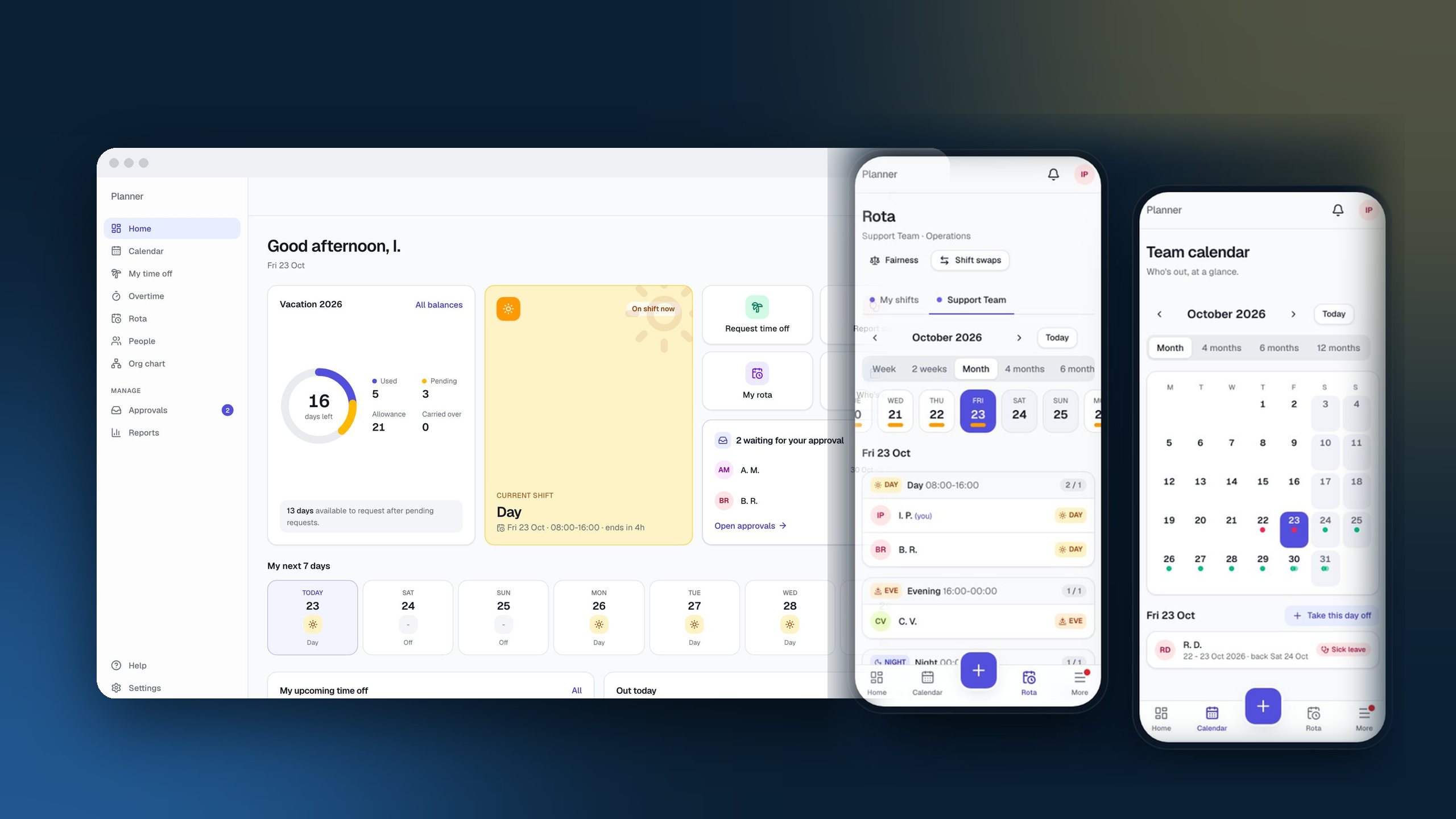

Web applications and multi-tenant SaaS platforms
From business analysis to production - React/Next.js front-ends, Node.js/.NET APIs, and SaaS architecture with billing, auth, and roles built in.
- Multi-tenant
- Architecture
- React + Next.js
- Front-end
- Node.js + .NET
- APIs
Illustrative view
Software people use every day.
Four pieces almost every SaaS platform contains, built as real products with every detail considered.
Fast interfaces with properly isolated per-client data that stay clear even at scale.
- Per-client data isolation
- Role-aware views
- Server-rendered interfaces for speed
Multi-tenancy built in from day one.
Four layers, each with its own job, connected by an architecture we can support for the long term.
Front-end
Fast interfaces, server-rendered where it matters for performance.
API layer
Typed, documented, versioned services.
Multi-tenant core
Billing, auth, roles, and permissions as core infrastructure.
Data
Proper per-client data isolation, with safe migrations.
One application, separate data for every client.
Every client works in the same application, and their data stays isolated at the storage level.
From idea to a platform in production.
Four phases, each with concrete deliverables.
Discovery and scoping
We map the real business workflows and define what belongs in v1.
- Business workflow map
- Scope of the first release
- Prioritized backlog
Design and architecture
Wireframes, data schema, and technical decisions documented before any code.
- Wireframes
- Data schema
- Documented technical decisions
Build and iterate
Short sprints, regular demos, feedback folded in as we build.
- Short sprints
- Regular demos
- Feedback folded in continuously
Launch and support
Production deployment and ongoing engineering after launch.
- Production deployment
- Ongoing engineering
- Post-launch iterations
An independent team, or one embedded in yours.
Two flexible models, one principle: stronger delivery with no extra noise.
Independent teams
Frontend, backend, DevOps, database, QA, business analysis, and project management roles, organized around defined outcomes.
Integrated teams
Specialists embedded with the client team, sharing ceremonies, backlog, standards, and knowledge transfer while capacity scales.
Two models. One operating principle: make delivery stronger without adding noise.